 |
|
An introduced traveller The Cattle Egret (Ardea ibis) is a medium-sized, largely ground-dwelling white bird with a tan flush to its plumage during breeding. It is found in lowland south and central Victoria near water courses, wetlands, swamps and the coast, often in paddocks associated with domestic cattle, where it feeds on a range of small animals including grasshoppers, frogs, crustaceans and lizards. The species is not native to Victoria and was first recorded in this state in 1949 but how it arrived here and where from is not entirely clear. The original distribution of this species was northern Africa,
southern Spain and southern Asia where it was commonly associated
with large grazing mammals such as cattle, buffalo, wildebeest and
zebra. Around the end of the 19th and beginning of the
20th centuries numbers began to increase as the
geographic range expanded into southern Africa and into larger areas of
sea-east Asia. At about this time a few birds were seen in the
north-east coast of South America and by the mid 1900s they were
breeding in the USA. In 1933 a small colony of 18 birds was
transported from India to Derby in north-western Western Australian as
it was considered to be a beneficial species for cattle. The
theory was that while cattle would assist the egret in disturbing
invertebrates and small vertebrates for them to feed on, the egret
would benefit the cattle by feeding on flies and ticks, and by keeping grasshopper
numbers down. It is believed that this colony was not successful but
nevertheless within two decades there were large numbers of Cattle
Egrets in the Northern Territory, along the east coast of Queensland and
in northern NSW. |
| Ardea ibis - Cattle Egret |
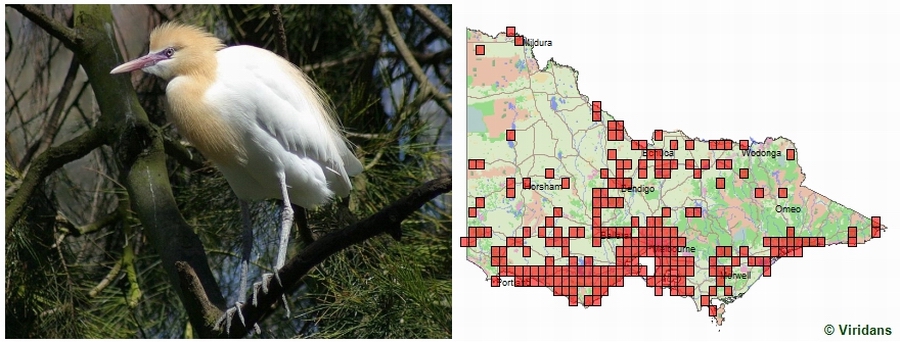 © Paul Gullan/Viridans Images |
|
While it is possible that Cattle Egrets have been visitors to northern Australia for centuries it is clear that the species did not establish itself in this part of the country until the cattle industry matured. The rapid spread of the species in near-coastal regions throughout Australia is also connected to the grazing industry and the development of pasture for domestic livestock. Nevertheless the species is not categorised as an introduction to Victoria by the Department of Environment, Land, Water and Planning (DELWP). There has always been some ambiguity in Australia, and indeed in other countries, about how to categorise the dispersal of birds to new locations. If a species has been deliberately released into a country, or a new part of the country, then it may be considered to be an undesirable introduction and steps will be taken to remove, it or at least contain its numbers. This is the case with species such as the Common Blackbird, the Common Starling, the Mallard and the Spotted Turtle-dove. But when a species finds its way without human assistance then it may be regarded as a migrant, a vagrant or natural range extension. This is the case with species such as the Pied Heron, Kelp Gull, Cape Gannet, Letter-winged Kite and Lesser Frigatebird. However, these rules of thumb are not applied consistently. For example, the Laughing Kookaburra was deliberately released into Western Australia and Tasmania over 100 years ago yet the species has been adopted by those states as if it were a native - there are no plans in place to remove it. By contrast there is a more or less constant starling-watch in WA which is designed to keep this state free of what is regarded as an undesirable bird and a similar approach is taken to foxes by the Tasmanian government. In Victoria there are wild populations of Western Ringnecks and Scaly-breasted Lorikeets near Melbourne, that are known to be the result of aviary escapes rather than natural range extensions, and these have not been classified as introductions. The case of the Cattle Egret adds another complication to the classification process. Its presence in Victoria must be considered to be the result of human-induced changes to the rural and urban environment and it is at least arguable that its presence in Australia may be the result of deliberate introductions (there is no definitive evidence that the Derby colony was not the source of the northern Australian establishment, or perhaps the catalyst for it). The three other white egrets in Victoria - the Eastern White Egret, Intermediate Egret and Little Egret - are all listed as threatened under the Flora and Fauna Guarantee Act (FFG) and the arguments used for the listing include change of wetland habitats by human activity and the lack of substantial breeding colonies. The Cattle Egret is not listed under the FFG even though there are no breeding colonies for it either. The main reason for its not being listed is that the populations appear to be on the increase while those of the other species appear to be declining. It is estimated, by some authorities in the USA, that the Cattle Egret numbers in that country now exceed those for all other egret species combined. This follows similar, but less well-documented, accounts of the species invasion from other countries. In Victoria, the Cattle Egret is now the second most abundant egret and its pattern of distribution is very similar to that of the other three species - it is often found in the same places. The possibility that the introduced egret may be competing with the natives species is clearly a very real one yet there is nothing in the Australian avian literature nor the FFG documentation to suggest that this might be the case. Current thinking is that the unusual feeding behaviour of Cattle Egrets and the different breeding timetables mean that the species does not compete for food or nesting sites with native egrets and herons. The concept that the presence of Cattle Egrets in Victoria is completely benign is an unusual one for such a widespread and relatively large bird. It is certainly unique amongst Victorian fauna to have an introduced species which is increasing in numbers, while closely related and threatened local species are in decline, and to determine that there is no causal relationship. © Paul Gullan, Viridans Biological Databases
|