 |
|
A native weed Pittosporum undulatum (Sweet Pittosporum) is a dense, broad-leafed shrub to about 15 m tall, with sweetly-perfumed white flowers and orange fleshy fruits. The main natural habitat of this species is Warm Temperate Rainforest of East Gippsland although it is possible that native populations once existed in protected gullies as far west as Westernport, about 100 km south-east of Melbourne. The species is extremely popular in cultivation and has escaped into a wide range of vegetation communities to which it is not native. All the populations around Melbourne, and to the west and north, should be regarded as naturalised aliens, indeed the majority of the records west of the Gippsland Lakes, are also likely to be the result of introductions. Pittosporum undulatum was one of the earliest Australian
shrubs to be recognised as a suitable candidate for cultivation.
It was collected by Joseph Banks and Daniel Solander from near Botany
Bay in 1770 and specimens, including fruit, were returned with them to
England in 1772. Very shortly after this Banks formally
described the genus and by 1802 Pittosporum undulatum was determined to
be distinct from the other Australian species by the French botanist
Etienne Ventenat. |
| Piitosporum undulatum - Sweet Pittosporum |
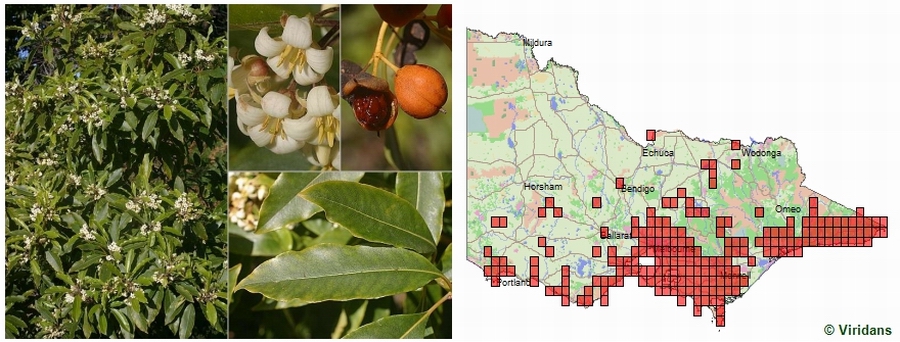 © Paul Gullan/Viridans Images |
|
The introduction of the blackbird, as a vector for the seeds, and a reduction of the fire frequency in Victorian forests, almost certainly helped Pittosporum to become established in vegetation communities from which it had previously been absent. It is currently regarded as one of the most troublesome woody weeds of native vegetation in semi-urban and country Victoria and despite active control measures it still appears to be increasing its geographic range - there has been a 60% increase in records for the species in Victoria in the past decade. Warm Temperate Rainforest (WTRF) is a vegetation community in which Pittosporum undulatum is an unambiguous component, and WTRF is listed as threatened in Victoria under the Flora and Fauna Guarantee Act (FFG). This, of course, presents a potential management problem for the species which has already become something of a dilemma in NSW where a similar situation exists. If Pittosporum is found growing in a woodland north of Melbourne, or in a rainforest in the Otway Ranges, then it is clearly an invader and removing it from the native vegetation is the appropriate plan of action. If it is present in a disturbed rainforest gully, 10 km north of Bairnsdale, in East Gippsland, then a management program for the restoration of an FFG-listed community should include maintenance of Pittosporum numbers, as the species is most likely to be native to this vegetation. If it is found in a disturbed woodland 5 km north of Bairnsdale, and away from any gully, then the management plan might regard Pittosporum as an invader to this type of vegetation and include a program for its eradication. And this is the dilemma. It is not always clear when Pittosporum is fighting to survive in its natural habitat and when it is aggressively invading a new one. This problem is particularly difficult to deal with in areas, such as East Gippsland, where Pittosporum is within its geographic range but may be outside of its natural habitat. This problem has become so acute in similar areas of NSW that the government has issued guidelines and warnings to stop the indiscriminate removal of Pittosporum until an investigation of the vegetation in which it is growing has been carried out. Pittosporum undulatum isn't the only native Victorian species that grows outside of its natural range but it is probably the most aggressive of the few that are considered to be problem weeds. Some of the more obvious other species include Acacia longifolia (both sub-species), Grevillea rosmarinifolia (and its many cultivars) and Melaleuca armillaris, all of which have been widely planted across the state. The most unusual example, however, is possibly the prostrate herb, Tribulus terrestris, which is also a declared noxious weed in Victoria. It has increased its range by virtue of very hard spiny fruit which easily get picked up by the tyres of motor cars and trucks and moved along the state's highways. © Paul Gullan, Viridans Biological Databases
|