 |
|
An urban weed Cenchrus clandestinus (Kikuyu) is a dense, mat-forming, perennial grass with very short flowering stems. In summer, the only indication of flowering is the long, fine filaments of the stamens which extend beyond the leaves like short spider webs. Cenchrus is found in urban parks, gardens and nature strips, rural parks and roadsides and disturbed coastal sites across lowland Victoria where the rainfall usually exceeds 600 mm a year. Cenchrus is native to tropical east Africa where its
common name, Kikuyu,
is taken from the Anglicised form of the name for people of that region.
It was introduced into Australia as a turf and pasture grass, in the
early 20th century and probably became naturalised in
Victoria by the 1940s. The distribution map below gives the
impression that Kikuyu is common in the southern part of the state, but
the raw data shows that 90% of the records come from built-up and
coastal areas around Port Phillip Bay and Westernport, including the
Melbourne metropolitan area. Most of the populations that are more
than 100 km from Melbourne are isolated and from roadsides, parks and
sports fields. There has been very little invasion of Kikuyu into
native vegetation - unless it is very disturbed - or to established
pastures. |
| Cenchrus clandestinus - Kikuyu |
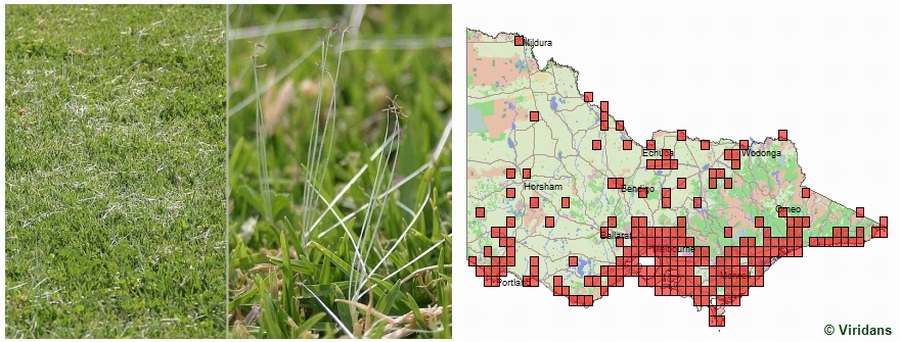 © Paul Gullan/Viridans Images |
|
Kikuyu is a popular pasture species in many places in the world because of its hardiness and longevity but in Victoria it has been used primarily for lawns and playing fields. Its distribution across the state is indicative of this use and there is hardly a large patch of lawn in the Melbourne metropolitan area that is without it. Despite this widespread cultivation it hasn't been a successful invader of pasture and bushland, possibly because it rarely reproduces from seed (at least in Australia). The expansion of Kikuyu is by runners (stolons and rhizomes) which spread both outwards from, and criss-crossing within, a population. The criss-crossing makes the turf dense, often to the exclusion of all other species, and means the advancing edge is supported by a well-supplied root system behind it. Almost everywhere that Kikuyu is regarded as a major weed is in areas that have been heavily disturbed and often completely cleared of other plants - e.g. ditches, drainage lines, pathways, vacant building blocks. The problem with the Kikuyu is that once established it is very difficult to remove - ironically the principal reason for planting it in the first place. Kikuyu has not been declared a noxious weed in Victoria (although it is in other places such as the USA) but it is regarded as a potential candidate for this classification by the Department of Primary Industries (DPI). To emphasise this point the DPI has produced a map showing the results of an environmental modeling procedure which predicts that Kikuyu has a high probability of invading a huge area of the state, particularly in the south-western volcanic plains. Curiously, however, the model does not predict the areas around Melbourne where most of the populations are. The current empirical evidence does not support this model for although Kikuyu has probably been in Victoria for at least 80 years and it has been introduced to most of the areas in which is it capable of growing, it hasn't spread very far from where it has been originally cultivated. It seems more likely that Kikuyu is, in Victoria, an urban weed and not an environmental or agricultural one. © Paul Gullan, Viridans Biological Databases
|