 |
|
A weed in waiting Disa bracteata (South African Orchid) is a ground orchid to about 30 cm tall with small yellow, green and brown flowers arranged in a dense spiral on fleshy stems. It is known from a range of disturbed woodland, heathland and grassland environments of lowland Victoria but its full geographic and ecological potential is yet to be determined. Disa bracteata is native to South Africa where it is one of the less spectacular members of this large genus. It is the only orchid species in the state that has become naturalised outside of cultivation. Disa is a recent introduction to Victoria which was first formally recorded from near
Bacchus Marsh, west of Melbourne, in 1994 (but was noted by some
botanists a few years earlier) and has since been found in around 50
localities, mostly in the western half of the state. The first Australian
record was from Western Australia in 1944, then in 1988 it was
discovered in South Australia, and recently there has been single record
for Tasmania, at Bridport, on the north-east coast. Numbers in WA
and SA are now very large in some areas, especially those that have
undergone physical disturbance, and in Victoria both the number and size
of populations is on the increase - the number of records has more than
doubled in the past ten years - as does the geographic
range. At the moment Disa is not considered to be major
weed but its apparent spread in a short time is concerning Victorian
botanists. |
| Disa bracteata - South African Orchid |
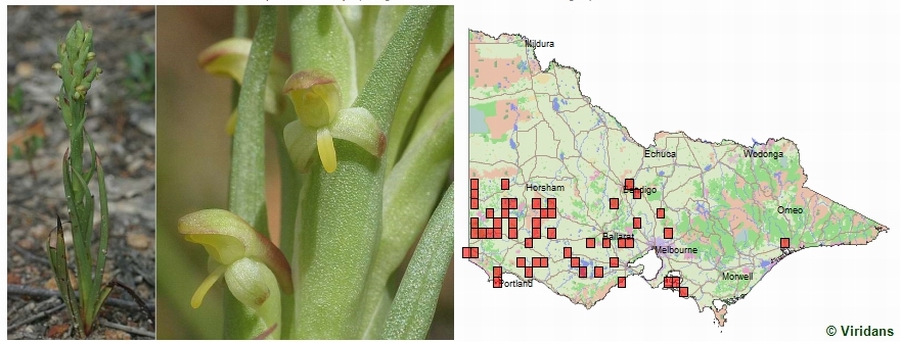 © Paul Gullan/Viridans Images |
|
Ground orchids are not normally regarded as weedy and none of the Victorian species are considered to be invasive, although some, for example the Onion Orchids (Microtis spp), do appear to respond well to habitat disturbance. So the success of Disa bracteata has caught botanists by surprise and questions are now being asked about the mechanisms of this phenomenon. The reason most ground orchids are non-weedy is that there are often two extra determinants for establishment and survival, in addition to the standard ones of soil, climate, exposure, which face all plants. One of these is a requirement for specific insect pollinators and the other is the need for particular kinds of fungi to be present in the soil to enable seed germination. The seeds of nearly all flowering plants contain both an embryo and a supply of food, called endosperm, to nourish the embryo while it is germinating. Orchid seeds are tiny and have virtually no endosperm so they do not have the necessary energy resources for germination without help. They get this help from some species of soil-borne fungi which will send threads (called hyphae) into the seeds - presumably in an attempt to draw nutrients from them. The orchid seed cells manage to compartmentalise the threads into tight coils (called pelotons) and then 'digest' them to provide the orchid embryo with the food it needs for the development of seedling leaves and roots. The orchid seed is acting like a Trojan Horse. It allows, perhaps encourages, the fungus to invade its cells and then becomes parasitic on the fungus. Often, when the orchid is mature, it terminates the connection with the fungus, but in other cases (especially when the orchid has little or no photosynthetic ability) the association is retained. Many orchid species will only germinate with the aid of one or a few species of fungus so their distribution, and hence ecological success, is heavily dependent on suitable conditions for the fungus. Disa bracteata appears to be able to form an association with a large number of fungal partners, especially those that can survive in disturbed soils, thus it is much less limited in the places and conditions in which it can become established. Nearly all ground orchids are pollinated by insects and some are very specific with respect to the insects that can act as vectors, particularly those that use pheromone mimicry - e.g. species such as Cryptostylis subulata which produces a chemical similar to that released by female Lissopimpla wasps to attract the males. Consequently, the presence of suitable insects in the area at flowering time is often critical to the success of seed generation for orchids. Disa bracteata appears to be self-pollinating (at least in Australia) which, although not the best thing for genetic variability, is very useful when a guarantee of a large number of seeds is required, and Disa may produce seeds in the millions. Orchids are well known for the range of adaptations to specific environments and insect pollen vectors, and it is these that have made them fascinating to botanists and horticulturalists for centuries. However, it is the lack of specific adaptations that has allowed Disa bracteata to become a successful invader in Australia along with the execution of some of the standard tactics for all good weeds - that is, it grows almost anywhere, especially on disturbed ground, and reproduces in large numbers. © Paul Gullan, Viridans Biological Databases
|