 |
|
A rare species that may not exist The Helmeted Honeyeater (Lichenostomus melanops cassidix) is an olive-green, yellow and black songbird with a noticeable small yellow crest on its forehead. It lives in woodlands and forests along creeks and small rivers in south-central Victoria. In the past 100 years its population, always small and with a restricted range, has contracted to a couple of creeklines south of Yellingbo, about 50 km east of Melbourne, where perhaps 50 or so individuals are living in the wild. It has been classified as critically endangered in Victoria, endangered in Australia (EPBC) and is listed under the Flora and Fauna Guarantee Act (FFG). It was declared the state bird of Victoria in 1971. The Helmeted Honeyeater is the most written about, most researched
and most heavily managed native Victorian bird. It was celebrated
by John Gould when, in 1867, he described it as a new species,
Ptilotis cassidix (all honeyeaters were at that time placed in the
genus Ptilotis) and went on to declare that it was the most
beautiful of all the honeyeaters. He later produced the, now
famous, first painting of the bird in his Supplement to the Birds of
Australia. Unfortunately Gould was living in London at the
time and never saw the bird in the wild so his illustration (painted by
his wife Elizabeth with creditation) shows two
animals perched in a Banksia ericifolia, a shrub that would
have been well-known to him from his time in Sydney, but one that is not
found in Victoria. An addition to the slightly confusing start to
the Helmeted Honeyeater's scientific recognition was that Frederick
McCoy, the director of the Melbourne Museum, also published a
description of the species on the same day but he named it Ptilotis
leadbeateri. The fact that Gould accompanied his description
with an illustration meant that the former name held sway. |
| Lichenostomus melanops cassidix - Helmeted Honeyeater : Critically Endangered in Victoria : Endangered in Australia : Known only from Victoria |
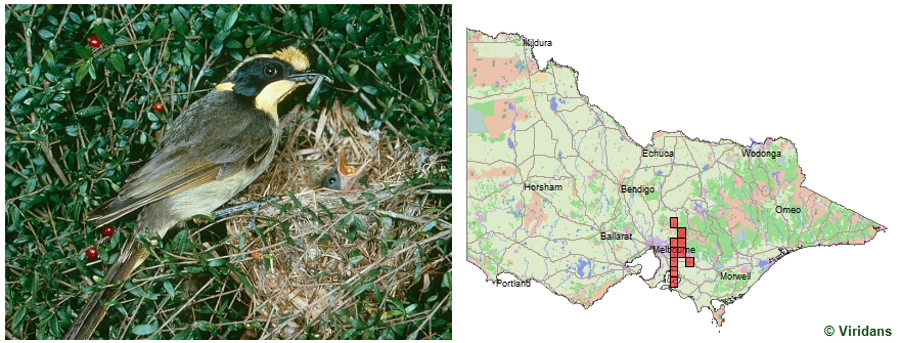 © Len Robinson/Viridans Images |
|
Once the recovery program was in full swing substantial effort was brought to bear on the Helmeted Honeyeater's lifestyle. Breeding pairs were captured and raised under controlled conditions at Healesville Sanctuary and any young that were successfully raised were re-introduced into the native population. In addition, eggs and nestlings were placed in unsuccessful nests of wild birds. Invasive Bell Miners, which compete for food, have been removed from the Yellingbo reserve, the native vegetation has been supplemented with desirable species, predator protection programs have been put in place, detailed monitoring of bird movements has been implemented, non-native animals and plants have been actively removed, and stream flow has been altered. Sadly, after nearly 20 years of this intensive management, and some successes, the populations are still more or less at the same levels as they were in 1990. It could, of course, be argued that without this effort the Helmeted Honeyeater might be extinct by now, but it could also be argued that the effort exceeds the conservation outcome. The Helmeted Honeyeater is recognised as the largest and most brightly coloured of the four races of the Yellow-tufted Honeyeater but it is conceded by most ornithologists that distinguishing it from the Gippsland race (Lichenostomus melanops gippslandicus) with any reliability is virtually impossible from field observations. In fact distinguishing one race of Yellow-tufted Honeyeater from the others is not something field biologists tend to do at all. There are no records within the Victorian Illustrated Fauna Information System for Lichenostomus melanops gippslandicus or L. m. meltoni (both of which are known from Victoria), the only race listed is L. m. cassidix and then all other records are represented as Lichenostomus melanops - the Yellow-tufted Honeyeater. The Birds Australia atlas doesn't distinguish between the races either and nor do any of the major Australian bird field guides (at least with respect to their distribution). A question that may be asked at this point is, if it is so difficult to distinguish between the helmeted race and the Gippsland race of the Yellow-tufted Honeyeater, what is it that the Helmeted Honeyeater recovery program is trying to conserve? Is it simply a slightly bigger, brighter and more prominently crested version of a common and widespread species? Is it possible that there are individuals of the Gippsland race, in central or eastern Gippsland, which have the same characteristics but haven't been called Helmeted Honeyeaters because we 'know' that they don't live so far east? What does the fact that eggs from wild Helmeted Honeyeaters can be placed in nests of captive Gippsland race pairs and raised to maturity mean with respect to the distinctiveness of the two races? These questions may appear to be mischievous, and they will not be heeded because there is now too much at stake in the program (it is after all the state bird), but it should be noted that there is no such ambiguity concerning the classification of the other faunal emblem of Victoria, Leadbeaters Possum. It is clearly a species in its own right and is unlike any other possum in the country. The same can be said of all other bird species in Victoria that are classified as rare or threatened in this state, the Helmeted Honeyeater stands alone as the only bird on that list that is not a distinct, full species. © Paul Gullan, Viridans Biological Databases
|