 |
|
A rare animal that is an invader The Kelp Gull (Larus dominicanus) is a large black-and-white sea-bird that feeds on marine invertebrates and vertebrates, eggs of other birds, fledglings and carrion. It is found along the coastline in similar areas to the Pacific Gull (Larus pacificus) and seldom ventures further inland. The Kelp Gull is not listed as rare or threatened in Victoria or Australia, it is classified as Least Concern in the IUCN Red Book. Until the late 1950s the Kelp Gull was considered to be a resident of
coastal South Africa, South America, New Zealand and some southern
Pacific islands. There are two sub-species, L. d. vetula (Cape
Gull) which breeds in South Africa and is considered by some
ornithologists to be a distinct species, and L.d. dominicanus
(Kelp Gull or Karoro in New Zealand) which breeds in the other
countries. The dominicanus sub-species was recorded as a
vagrant in Australia from 1943 (and perhaps earlier) but it was in 1958
that the first birds began breeding in this country. Since that time
Kelp Gulls have increased in number along the southern and eastern
coasts of Australia and records of breeding animals are known from
Westernport, near Phillip Island, since the late 1960s. |
| Larus dominicanus - Kelp Gull |
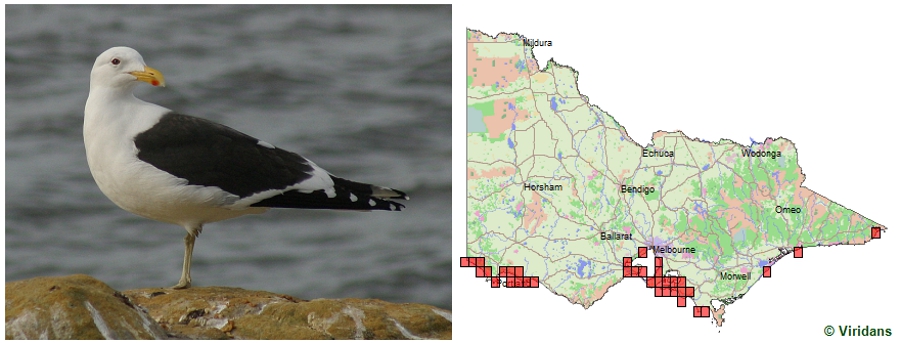 © Paul Gullan/Viridans Images |
|
In 1981 a single Cape Gannet (Morus capensis) joined a large colony of Australasian Gannets (Morus serrator) at Wedge Light in Port Phillip Bay, south of Melbourne. The animal was probably a wandering individual which came from near South Africa where the species is quite common and it was the first time this species had been recorded for Victoria. A few years later several more individuals were recorded from another Australasian Gannet colony on Lawrence rocks near Portland in south-western Victoria. The new arrivals, which look very similar to the local birds, have settled in well enough to breed with Australasian Gannets and there are a now a few hybrid individuals in Victoria. The Cape Gannet was initially classified as rare in Victoria, then critically endangered and now is unclassified. The species is classified as vulnerable in the IUCN Red Book An invasion of this sort by species released by humans (e.g. Mallards which breed with local Pacific Black Ducks) is almost always regarded as something undesirable that needs to be controlled. With species that get here by themselves there is an ambiguity that seems to have been left unresolved. If the Kelp Gull and Cape Gannet are truly native their relatively low numbers and uncertain breeding status should classify them as threatened at some level. If they are not native then they should be categorised as such and perhaps eradication programs need to be put in place. © Paul Gullan, Viridans Biological Databases |